British PM, along with Myanmar's opposition leader, calls for suspension of economic sanctions during visit to country
David Cameron and Myanmar's opposition leader have called for the suspension of economic sanctions against the South Asian nation after holding landmark talks.
The British prime minister met Aung San Suu Kyi on Thursday at her lakeside home where she was held under house arrest ...for 22 years by the country's military government.
"If we really want to see the chance of greater freedom and democracy in Burma, we should respond when they take action," Cameron said.
"For the sake of a country that has been crying out for freedom after decades of dictatorship, and that is crying out for a stronger economy after so much grinding poverty, it must be worth taking that risk."
Cameron said an arms embargo against Myanmar should remain but it was right to suspend, but not lift, remaining sanctions.
The visit was the first by a British prime minister in decades and comes amid thawing relations between the once-pariah state and Western nations.
Earlier, Cameron met Thein Sein, Myanmar's reformist president, who took over from Than Shwe, the general who was was in charge as Suu Kyi and other political prisoners' rights were violated.
The European Union is due this month to review its sanctions in response to political and economic reforms undertaken by the civilian government that came to office a year ago when the military government partially ceded power.
Quoting a source from Cameron's office, the Reuters news agency said it was unlikely all EU sanctions against Myanmar would be lifted.
"We will want that decision on the 23rd of April to be the right balance that recognises the great progress that's been made ... versus not taking our foot too much off the pedal and going backwards," the source added.
Britain, Myanmar's former colonial ruler, has traditionally stuck to sanctions because of human rights concerns and its shift is likely to clear the way for a suspension of the measures later this month.
'Thein Sein genuine'
Suu Kyi, a Nobel Peace Prize laureate whose support is seen as crucial for any easing of the sanctions, including those imposed by the US, also called for a suspension of the measures.
"This would strengthen the hands of the reformers - not just the suspension but the fact that there is always a possibility of sanctions coming back again if the reforms are not allowed to proceed smoothly," she said.
"We still have a long way to go but we believe that we can get there. I believe that Thein Sein is genuine about democratic reforms."
Cameron said people should be "under no illusion about what a long way there is to go", and said Myanmar's leaders want to demonstrate that moves towards democracy were "irreversible".
The fact that Myanmar has been "largely unexploited in terms of business opportunities" is part of what is driving a steady stream of foreign dignitaries, including Hillary Clinton, the US secretary of state, and her British counterpart, William Hague, to the nation, Al Jazeera's Wayne Hay, reporting from neighbouring Thailand, said.
Myanmar's military rulers ceded power to a quasi-civilian government following a November 2010 election marred by opposition complaints of rigging, and won by a party set up by the military.
"In a world where there are many dark and depressing chapters of history being written there is a potential chapter
of light," Cameron said ahead of his visit.
"Of course we should be sceptical, of course we should be questioning."
The new government has released hundreds of political prisoners and introduced a wave off reforms including loosening media controls, allowing trade unions and protests, talks with ethnic minority rebels and sweeping economic changes.
In parliamentary by-elections earlier this month, Suu Kyi was elected to Myanmar's parliament after decades as a prisoner.
The last election she won under her NLD party in 1990 was not recognised by the military government.
Saturday, 14 April 2012


Friday, 13 April 2012
David Cameron arrives in Burma for historic trip

Prime Minister David Cameron met Burma's president, Thein Sein, in Nay Pyi Taw
David Cameron has become the first UK prime minister to visit Burma in more than 60 years after arriving in the capital Nay Pyi Taw.
He met President Thein Sein and is to hold discussions with pro-democracy leader Aung San Suu Kyi in Rangoon.Speaking on arrival, Mr Cameron said the government had to demonstrate that moves to democracy were "irreversible".
He is the first Western leader to visit Burma since Ms Suu Kyi's success in a series of parliamentary by-elections.
Burma was ruled for almost half a century by a military junta that stifled almost all dissent and wielded absolute power. The EU, US and other nations imposed sanctions.
The first general election in 20 years was held in 2010.
The installation of a military-backed, nominally civilian government in March 2011 and a series of reforms since - including the release of hundreds of political prisoners - has led to speculation that decades of international isolation could be coming to an end.
'Shining example' "There is a government now that says it is committed to reform, that has started to take steps, and I think it is right to encourage those steps," Mr Cameron said.
But he added: "We should be under no illusions about what a long way there is to go and how much more the government has to do to genuinely show this reform is real and that it's irreversible, and we should be very cautious and very sceptical about that."
He also said he wanted to meet Ms Suu Kyi, describing her as "a shining example for people who yearn for freedom, for democracy, for progress".
Mr Cameron is the first serving British prime minister to visit Burma since it gained independence from Britain in 1948.
It is the final leg of his tour of South East Asia promoting UK interests.
EU foreign ministers are to discuss policy towards Burma on 23 April.
Sanctions, which include an arms embargo and an assets freeze imposed on nearly 500 people, are due to expire on 30 April. Earlier this year, the EU lifted travel bans on more than 80 senior officials, including the president.
If they are satisfied that recent steps taken by the government are likely to be sustained, they could ease certain financial sanctions.
BBC South East Asia correspondent Rachel Harvey, in Rangoon, says although the UK has a reputation within the European Union as being among the most cautious about the recent changes in Burma, the pace of reform in the country is impossible to ignore.
Mr Cameron will want to use his meetings to help shape Britain's position within that argument, she says.

David Cameron was mobbed by students in Malaysia when he spoke at a university on Thursday
On Thursday, Mr Cameron told BBC Radio 5 live he would meet the Burmese president and "thank him for the work that he has done" on democratic reform.Mr Cameron is expected to tell the president the UK is prepared to provide support to the country in areas such as how to build a democracy, tackling corruption and peace and reconciliation, if the country moves ahead with reform and the EU sanctions are lifted.
The PM is then set to take part in a joint news conference with Ms Suu Kyi, who was recently elected to parliament after two decades spent mostly under house arrest.
The pair are then expected to have a private dinner in Rangoon.
'Purely political' visit Earlier, while in Malaysia, Mr Cameron said he and other regional leaders believed the Burmese government's desire for reform was genuine.
"I hope that following my meetings I will have the confidence to go back to my country, back to others in the European Union, and argue that change in Burma is irreversible... and, in a world of difficult and darkness, and all sorts of problems, here is one bright light we should encourage," he said.
Ten members of the business delegation, which includes defence firms, accompanying Mr Cameron on his tour are also in Burma.
However, Downing Street has insisted the visit is purely political and the businessmen will merely be carrying out "cultural" activities.
On Thursday, former Labour minister Baroness Kinnock, the chairwoman of the all-parliamentary group on Burma, said the PM was correct to acknowledge there had been progress.
But she warned against any "chipping away of sanctions", saying it was too soon to consider lifting the arms embargo and restrictions on key industries such as mining and timber when the military still had a monopoly of power.
Mr Cameron is not the first major Western figure to visit the country. US Secretary of State Hillary Clinton made a landmark trip to Burma in December 2011.
Wednesday, 11 April 2012
Suu Kyi meets Myanmar president
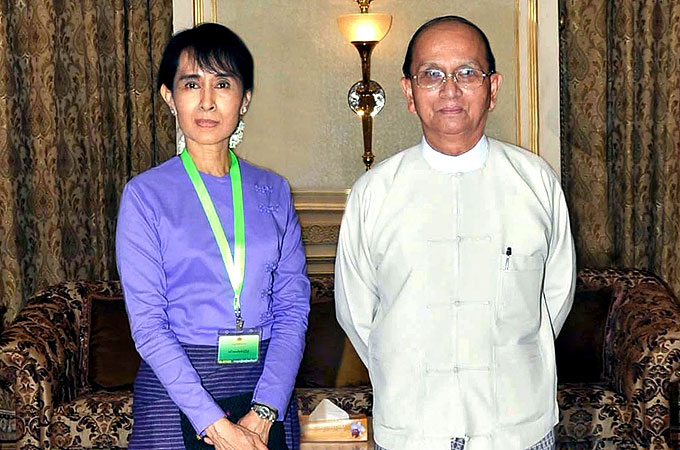
Suu Kyi met President Sein, right, for the second time since August 2011
The pair met at the president's official residence in the capital, Naypyidaw, on Wednesday, Suu Kyi's security chief Khun Tha Myint said. It was their second meeting since the former general took office last year, marking the end of nearly half a century of military rule.
"She will have lunch with the president's family after the meeting," Myint said.
Al Jazeera's Aela Callan, reporting from neighbouring Bangkok, said: "Both have made no secret of the fact that they need to work together, hence why this meeting has a formal as well as a private side to it."
The 66-year-old Nobel laureate, who spent 15 of the past 22 years locked up by the military rulers, will take her seat in the lower house of parliament for the first time on April 23.
Her National League for Democracy (NLD) party managed to win 43 of the 44 seats it contested, becoming the main opposition force in a national parliament that remains dominated by the military and its political allies.
Suu Kyi has rejected suggestions that she could enter government. But she has not ruled out taking on an advisory role, particularly on the subject of the ethnic minority conflicts that have gripped parts of the country since independence.
Political reforms
In August 2011, Suu Kyi and Sein held talks as the country embarked on a surprising series of reforms, including welcoming Suu Kyi's party into the political mainstream and freeing scores of political prisoners.
Observers say Myanmar's rulers now need Suu Kyi in parliament to bolster the legitimacy of the political system and spur an easing of sanctions.
With Myanmar being increasingly accepted by the international community, David Cameron, the British prime minister, is due to visit the country on Friday to hold talks with both Sein and Suu Kyi.
His visit will be the first by a Western elected head of government since the military handed power to a nominally civilian government last year following a controversial 2010 election boycotted by the opposition.
The US announced last week it would ease some of its sanctions against Myanmar, but said measures would remain against those opposed to reform.
The International Crisis Group think-tank on Wednesday called on the West to lift remaining sanctions "without delay" to help the reform process, saying the government was unlikely to reverse course.
"Myanmar has turned away from five decades of authoritarianism and has embarked on a bold process of political, social and economic reform," the think-tank said in a report.
Wednesday, 4 April 2012
Bridge security personnel collect toll from vehicles and travelers
Maungdaw, Arakan State: Bridge security personnel have been collecting toll from vehicles and travelers since it started for public service last six months, said a village administrator office member from Mingalagyi village.
The road – Maungdaw – Mingahlagyi villages – had finished recently with villagers work forced, the member said.
“The road has three bridges – Shwezar – Kayoungchaung – Hlapoekaung villages to connect each side to run the road smoothly and each bridge has security personnel for safeguard of bridge.”
But, the security are collecting toll from Rohingya community who pass the bridge by forcefully,said a teacher from Shwezar village.
“The bridge security personnel are only to watch and guard the bridge only not to collect the toll.”
The bridge security personnel are collecting kyat 2000 per a vehicle and they also checked the travelers ( Rohingya) identity card and forced the traveler to pay 100 kyat to them, said a driver who ply on this road.
“The security personnel forced the Rohingya (travelers) to pay money event they have all the documents to travel. The officers are using what they (officer) want to do to the local people. There is no law for them.”
“Sometimes, the security personnel robbed the travelers when they travel on the night (dark) and took all the belonging.”
Recently, at Shwezar bridge, Rashid and other two ( security personnel) are robbing travelers who go to their home from Maungdaw market at night, said a businessman from Maungdaw.
“The villager complained to the village administrator officer and concern authority ( local Nasaka) about harassment of security officers of bridge, but action was taken till now.”
The road – Maungdaw – Mingahlagyi villages – had finished recently with villagers work forced, the member said.
“The road has three bridges – Shwezar – Kayoungchaung – Hlapoekaung villages to connect each side to run the road smoothly and each bridge has security personnel for safeguard of bridge.”
But, the security are collecting toll from Rohingya community who pass the bridge by forcefully,said a teacher from Shwezar village.
“The bridge security personnel are only to watch and guard the bridge only not to collect the toll.”
The bridge security personnel are collecting kyat 2000 per a vehicle and they also checked the travelers ( Rohingya) identity card and forced the traveler to pay 100 kyat to them, said a driver who ply on this road.
“The security personnel forced the Rohingya (travelers) to pay money event they have all the documents to travel. The officers are using what they (officer) want to do to the local people. There is no law for them.”
“Sometimes, the security personnel robbed the travelers when they travel on the night (dark) and took all the belonging.”
Recently, at Shwezar bridge, Rashid and other two ( security personnel) are robbing travelers who go to their home from Maungdaw market at night, said a businessman from Maungdaw.
“The villager complained to the village administrator officer and concern authority ( local Nasaka) about harassment of security officers of bridge, but action was taken till now.”
Nasaka forces villager to pay pebble as fine in Maungdaw
Maungdaw, Arakan State: The Nasaka personnel from its headquarters have been checking nearby villages for repairing of houses and fined with pebble pits, said a village administration officer from Nwahyondaung village.
The Nasaka personnel went to the villages – Nwahyoudaung, Maung Hnama and Kyiganpin – nearby Nasaka Headquarters where the Nasaka checked the compounds of the villagers for searching if the villagers repaired their houses or extension of the house or toilets. If the Nasaka found any things new in the house, they (Nasaka) took photograph the things and summoned the villager to the Head office, he more added.
At the head office, the officer checked the field reports and imposed a fine of pebble pits of 5 to 10, said an elder from Kyiganpin village.
“A pit is measure with 9 feet long, 9 feet wide and 1 foot high with pebble and one pit cost around 5000 kyat recently.”
“To build the road, we need pebble and you have to pay for road where you will go on this road,” the officer said.
But, the Nasaka officers are asking not pebble pits, the officers want only the money as per recent market, said a teacher from Maung Hnama village.
Last month, the Township administration officer ordered to village admin officers to issue permission of build repairing with detail mention. Now, the Nasaka are collecting information of building repairing and forced to fine them, said a politician from Maungdaw.
The Nasaka personnel went to the villages – Nwahyoudaung, Maung Hnama and Kyiganpin – nearby Nasaka Headquarters where the Nasaka checked the compounds of the villagers for searching if the villagers repaired their houses or extension of the house or toilets. If the Nasaka found any things new in the house, they (Nasaka) took photograph the things and summoned the villager to the Head office, he more added.
At the head office, the officer checked the field reports and imposed a fine of pebble pits of 5 to 10, said an elder from Kyiganpin village.
“A pit is measure with 9 feet long, 9 feet wide and 1 foot high with pebble and one pit cost around 5000 kyat recently.”
“To build the road, we need pebble and you have to pay for road where you will go on this road,” the officer said.
But, the Nasaka officers are asking not pebble pits, the officers want only the money as per recent market, said a teacher from Maung Hnama village.
Last month, the Township administration officer ordered to village admin officers to issue permission of build repairing with detail mention. Now, the Nasaka are collecting information of building repairing and forced to fine them, said a politician from Maungdaw.
40 NLD seats confirmed wins; results for five more to come soon
The Burmese Union Election Commission (UEC) announced on state TV on Monday the names of 40 MPs-elect in the April 1 by-elections. Results for five more parliamentary seats will be available soon, it said.
 All of the 40 confirmed winners are National League for Democracy (NLD) candidates: 35 seats in the Lower House, three seats in the Upper House and two seats in regional or state assemblies. The NLD on Monday said it may have won in 43 or more constituencies.
The 35 seats of in the Lower House included all six seats in Rangoon region's six constituencies and all four constituencies in Naypyitaw, the captital.
Meanwhile, according to the NLD, in the Rangoon constituencies, Aung San Suu Kyi won over 85 per cent of the vote in Kawhmu: she received 55,902 votes compared to 9,172 for her strongest rival, Dr. Soe Min, the ruling Union Solidarity and Development Party (USDP) candidate; a third candidate Tin Yi of the Unity and Peace Party (UPP) received 397 votes, according to the NLD.
The parliamentary by-elections were contested by a total of 157 candidates represent 17 political parties and independents, competing for 45 vacant parliamentary seats in 45 township constituencies in nine regions or states: Yangon, Mandalay, Ayeyawaddy, Sagaing, Tanintharyi, Bago, Magway, Mon and Shan as well as Naypyitaw.
An adviser to President Thein Sein said the government was surprised by the scope of the NLD victory.
“I think the Obama government, they are starting to believe that we are really changing, but we need to convince the other guys in Congress,” adviser Ko Ko Hlaing said in an interview with The Washington Post.
He said the president’s relationship with Suu Kyi, whom he has personally met only one time, is grounded on a strong understanding based on actions rather than words. Representatives of the two sides were in regular contact, he told the Post.
Will the election qualify as free and fair and prompt the quick removal of significant western sanctions?
U.S. officials said Sunday’s poll represents a “significant step,” despite reports of some campaign and election irregularities. Suu Kyi has not yet given a pronouncement on the overall election’s fairness. The NLD is in the process of compiling a report of abuses and irregularities.
“There are tangible moments that demand a tangible response to support ongoing reform,” said a senior U.S. administration official. The possibilities include a lifting of visa bands for travel to the United States; nominate a U.S. ambassador to Burma, lift some minor sanctions by presidential order; or initiate military exchanges.
The most dramatic action would be lifting U.S. sanctions barring foreign investment in Burma and imports from the country. That will probably be withheld barring more dramatic democratic reforms, including the release of all political prisoners and establishing a last peace in ethnic areas, where war has raged for decades.
“For now, people on the Hill are open to giving small things that are reversible,” a congressional aide told the Post. “I don’t think there’s any appetite yet for lifting the major sanctions.”
The by-elections were observed by foreign diplomats and United Nations officials based in Burma as well as more than 150 invited international observers and media persons from Asean, and its dialogue partners, including the European Union and the United States. The parliamentary by-election was the first held in the new era of the civil government after decades of no elections under military rule.
Suu Kyi, in a speech at NLD party headquarters, invited all parties to join together for national reconciliation and to bring peace and prosperity to the country. The NLD victory was a “people’s
Aung San Suu Kyi observes a poll station in Yedashe village, Kawmhu Township, on Sunday, April 1, 2012.
The 35 seats of in the Lower House included all six seats in Rangoon region's six constituencies and all four constituencies in Naypyitaw, the captital.
Meanwhile, according to the NLD, in the Rangoon constituencies, Aung San Suu Kyi won over 85 per cent of the vote in Kawhmu: she received 55,902 votes compared to 9,172 for her strongest rival, Dr. Soe Min, the ruling Union Solidarity and Development Party (USDP) candidate; a third candidate Tin Yi of the Unity and Peace Party (UPP) received 397 votes, according to the NLD.
The parliamentary by-elections were contested by a total of 157 candidates represent 17 political parties and independents, competing for 45 vacant parliamentary seats in 45 township constituencies in nine regions or states: Yangon, Mandalay, Ayeyawaddy, Sagaing, Tanintharyi, Bago, Magway, Mon and Shan as well as Naypyitaw.
An adviser to President Thein Sein said the government was surprised by the scope of the NLD victory.
“I think the Obama government, they are starting to believe that we are really changing, but we need to convince the other guys in Congress,” adviser Ko Ko Hlaing said in an interview with The Washington Post.
He said the president’s relationship with Suu Kyi, whom he has personally met only one time, is grounded on a strong understanding based on actions rather than words. Representatives of the two sides were in regular contact, he told the Post.
Will the election qualify as free and fair and prompt the quick removal of significant western sanctions?
U.S. officials said Sunday’s poll represents a “significant step,” despite reports of some campaign and election irregularities. Suu Kyi has not yet given a pronouncement on the overall election’s fairness. The NLD is in the process of compiling a report of abuses and irregularities.
“There are tangible moments that demand a tangible response to support ongoing reform,” said a senior U.S. administration official. The possibilities include a lifting of visa bands for travel to the United States; nominate a U.S. ambassador to Burma, lift some minor sanctions by presidential order; or initiate military exchanges.
The most dramatic action would be lifting U.S. sanctions barring foreign investment in Burma and imports from the country. That will probably be withheld barring more dramatic democratic reforms, including the release of all political prisoners and establishing a last peace in ethnic areas, where war has raged for decades.
“For now, people on the Hill are open to giving small things that are reversible,” a congressional aide told the Post. “I don’t think there’s any appetite yet for lifting the major sanctions.”
The by-elections were observed by foreign diplomats and United Nations officials based in Burma as well as more than 150 invited international observers and media persons from Asean, and its dialogue partners, including the European Union and the United States. The parliamentary by-election was the first held in the new era of the civil government after decades of no elections under military rule.
Suu Kyi, in a speech at NLD party headquarters, invited all parties to join together for national reconciliation and to bring peace and prosperity to the country. The NLD victory was a “people’s
ASEAN wants Myanmar sanctions to end

Leaders of ASEAN bloc representing almost 600 million people convened in Phnom Penh
Leaders of the Association of Southeast Asian Nations (ASEAN) "call for the lifting of all sanctions on Myanmar," Cambodian Secretary of State Kao Kim Hourn told reporters on the sidelines of the ASEAN summit in Phnom Penh.
The summit of the 10-member ASEAN bloc commenced in the Cambodian capital on Tuesday, just two days after by-elections in Myanmar saw pro-democracy leader Aung San Suu Kyi win her first seat in parliament.
ASEAN foreign ministers applauded the "orderly" conduct of the polls during talks, setting the stage for a strong endorsement from the bloc's leaders at Wednesday's conclusion of the two-day summit.
Representing almost 600 million people from disparate economic and political systems, the ASEAN bloc comprises Brunei, Cambodia, Indonesia, Laos, Malaysia, Myanmar, the Philippines, Singapore, Thailand and Vietnam.
Surin Pitsuwan, the ASEAN secretary-general, said the vote should contribute to the "reintegration of Myanmar into the global community", a reference to the possible lifting of sanctions.
Myanmar's human rights abuses and iron-fisted suppression of political dissent have often hijacked ASEAN gatherings in the past, much to the embarrassment of more democratic member-states.
But over the past 12 months the country's quasi-civilian government, led by President Thein Sein, has freed hundreds of political prisoners, eased media restrictions and welcomed the opposition back to the political fold.
At the last ASEAN summit in November, the country was rewarded for its efforts by being promised the bloc's chairmanship in 2014. Myanmar is eager too to win greater foreign investment with the prospect of sanctions being lifted.
Rocket launch
North Korea's planned rocket launch, described by Pyongyang as a bid to send a satellite into orbit but condemned by the United States and its allies as a thinly disguised missile test, is also on the the agenda for the Cambodia summit.
Albert del Rosario, the Philippine Foreign Secretary, said the ASEAN foreign ministers spoke with one voice against the nuclear-armed North's launch plans.
The Philippines, which lies beneath the rocket's proposed flight path, has lodged formal protests with Pyongyang's representatives at the United Nations, in China and at ASEAN.
"I think the countries that spoke on the topic ... were all of the opinion that we should be discouraging (North Korea) from undertaking that launch," Del Rosario said after the foreign ministers' meeting on Monday.
Regional tensions with China over disputed islands in the South China Sea are another vexing issue for the ASEAN leaders, diplomats said.
China has competing territorial claims in the sea with ASEAN members Brunei, Malaysia, the Philippines and Vietnam.
The US says it has a "national interest" in keeping the vital trade route open to shipping.
The sea is a conduit for more than one-third of the world's maritime trade and half its traffic in oil and gas, and major petroleum deposits are believed to lie below the seabed.
US ally the Philippines has been leading a push for ASEAN to form a united front and present China with a binding "code of conduct" in the sea, but other members argue that Beijing should be involved from the start.
There are also differences over the "internationalisation" of the rival claims, with Cambodia insisting they are matters for quiet diplomacy between ASEAN and China but the Philippines asserting the primacy of international law.
Subscribe to:
Posts (Atom)
About Me

- The Voice Of Rohingya
- Maung daw, Arakan state, Myanmar (Burma)
- I am an independent man who voted to humanitarian aid.