Tuesday, 10 July 2012

Update news of northern Arakan on July 10, 2012

Buthidaung Township:
Two villagers were killed by army on July 6, at Naya Para village nearby State Government High School of Buthidaung Town. They were identified as Nabi Hussain (35), son of Ali Akbar and Fokira (15), son of Gora Meah, said an elder from the village.

They were picked up by army in front of their houses while they were standing on the road at about 5:30 pm. They knew that they had to enter their houses before 6:00 pm, as the section 144 and the state of emergency have been imposing since June 10. However, suddenly, a group of army came to the spot and they were picked up and brought to a nearby Buddhist monastery where they were severely tortured by army. The victims thought that they would be killed, so they ran away from the monastery while the army is having tea. Sensing the matter, the army shot them from their behind and the both of them got injuries, said a close relative of the victims.
In the early morning, the parents of the victims were informed to see their sons in the monastery. When the parents were reached to the temple, the injured sons told their parents about their incident in details before their death. A few minutes later, both of them were dead. However, the dead bodies were handed over to their parents and asked them to bury quickly before the local people saw them.
Beside, on July 3, the police of Buthidaung town went to Dodan No.1 village and arrested Dil Mohamed, son of Abdullah, Abdu Kader, son of Sayed Karim and Mohamed Jubair, son of Maulana Nazir, hailed from Dodan No.2 village of Pron Chaung village tract.
In addition, the police also arrested Ano, and Kalu on June 15. Both of them belong to Dodan No.2 village under Pron Chaung village tract.
These arrestees have no crime and they are innocent.  But they were arrested over the allegation that they threatened to the Natala and Rakhine villagers which are nearby Yaung Chaung  Rohingya village. Rohingya villagers barred the Natala and Rakhine villagers who wanted to go to Buthidaung town for fear of Rohingya villagers’ attack and the Rohingya villagers gave grantee to the concerned authority that there will be no untoward incident against the Rakhine community.
Why did the army arrest the said two villagers before 6:00 pm?, asked a local elder.
Some of the Rohigyas were arrested because they violated the law, but there were also some of them who carelessly came out from their houses and were arrested. The Burmese authorities in Maungdaw, Buthidaung, Akyab (Sittwe) and other towns have mainly targeted Rohingya Muslims for arrest, torture and killing, but no actual action is yet taken in to Rakhine people despite their uninterrupted attacks on Rohingya Muslims across the Arakan State.
It is clear that the State government of Arakan State, the RNDP, local Rakhine Leaders, Rakhine youths    create the sectarian riots between two communities with the help of— police, Hluntin, Nasaka and army. It is proof that the Rakhine youths have been making arson attacks to the Rohingya villagers in front of the security forces.  The police and Hluntin are firing to the Rohingya villagers while the Rakhine racists set on fire the houses of Rohingya villages. This means that the government fully involves in the riots for political benefit. If this is not true, why the riots are still going on by one-sided against the Rohingya community?, said a  local leader.
Maungdaw Township:
Today at about 10:00 am, police and Hluntin with eight trucks went to Ward No. 5, Latha Yawa (Naitor Dil) village and Aytahliyah Para of Maungdaw Township to arrest Rohingya villagers. Of which, four trucks of security force were waiting at Naitor Dill and  other four trucks of security forces went to Aytahliyah village track. It is very strange that two trucks of female security forces are also accompanied by them. It is learnt that there is no female security force in Maungdaw town.  How and where the female security force came?  Why did they go to Rohingya villages?
Seeing the security force approaching to their villages by trucks, the villagers were fleeing from the villages.  So, the security forces returned to their camp without any attack.  However, the security forces arrested eight villagers from the paddy fields and roads while returning to their camps.

Update News of July 9, 2012

Natala and security forces destroy Holly Qurans, religious books and vandalize religious school
Thayet Gonetan (Sairkongbow) Madrasa (Religious school) of Maungdaw Township had been vandalized by Natala villagers accompanied by security forces today at about 12:30pm, according to an elder from village.

“Seven security forces accompanied by 50-Natala villager from Sairkongbow Natala village went to the said Madrasa and destroyed all Holly Qurans and Hadith books which were thrown to the water and Maungdaw-Aley Thankyaw road after tearing up all the books.”
The religious school has nearly 400 students, but they went to their homes since June 8 after closing the madrasa, said a religious teacher.
“The Natala villagers took away all the beds of the students and 4,200- kg rice from the Madrasa, which is stored for the boarding students. The Madrasa is established on the eastern side of Maungdaw- Aley Than Kyaw road and the Rohingya village is established on the western side of the road. Seeing the security forces, villagers did not dare to go there for giving protection.”
Update news in Maungdaw
Police officer U Than Tin accompanied by some police and some local Rakhine goons went the house of Rafique, hailed from Ward No. 5 of Maungdaw Town, at about 11:00 am today and looted gold, money and other valuables, which cost nearly kyat 30 million. They also destroyed the jeep of Rofique.
The police officer also destroyed five Rohingya shops with the help of police and local Rakhine goons and took away all the goods, which will cost Kyat 100 million. The shop owners are identified as two brothers Yasin and Ismail, sons of Osman from Pandawpin village.
The police also went to Khari Para of Maungdaw town and looted goods from some of the houses and the Nasaka accompanied by Rakhine youths took away goats from Washa Para of Maungdaw south, today.
The Nasaka is using a new tactic to arrest Rohingya youths by checking the family lists. As a result, Rohingya youths are not able to stay at homes and passing nights without sleeping. Almost, Rohingya youths do not appear in front of the Nasaka to avoid arrest and so they are canceled from the family list.
The Rakhine community of Maungdaw north has been hoisting Rakhine religious flag in every house since yesterday.
Rathedaung Township:
Sayed Alam (30), son of Fazal Rahaman and Sultan Ahmed (35), son of Rashid Ahmed were tortured to death by the army on July 7 because of entering mosque for prayer.
Buthidaung Township:
About 700 Rohingya prisoners are languishing in Buthidaung jail, who were recently arrested by Nasaka police, army and Hluntin during the sectarian riots. They are tortured everyday and have no clothes for taking bath. No one is allowed to visit them.

Sunday, 8 July 2012

Update News of Northern Arakan State, July 8, 2012

Maungdaw Township:

A 34-member parliamentary team —consisting of no local Rohingya MPs—led by Thura Shwe Mann visited Maungdaw Township, Arakan State, on July 8. But, the team only visited with Buddhist community, especially the Natala villagers and Monks who are  giving shelter  Mogh  and distributed relief goods to them. The team neither met with Rohingya Muslims nor gave any relief to them, said an elder from Mungdaw.

“There are some Buddhist refugees in Maungdaw Township who are Natala villagers – were brought to northern Arakan from Burma proper for new settlement.  On June 8, some of the houses of Natala villagers were burned down by Rohingya villagers and become refugees. Within two days, all the Natala villagers were brought to under Nasaka camps and some are being kept in Buddhist monastery at Maungdaw.  Whenever international visitors paid visit to Maungdaw Town, they only visited the Buddhist refugees by the local guidance. To show the international visitors, the concerned authorities such as— Nasaka and army— brought the Natala (Model) villagers from northern side of Maungdaw, Buthidaung and Rathedaung Townships to Maungdaw town.”
Rohingya villagers have been keeping in their villages since the violence was occurred. At present, they are facing acute crisis of ration, medicines and essentials, and are not allowed to buy anything from outside. Nasaka or police or Hluntin with the collaboration of Rakhine youths shot dead Rohingyas, if he will meet out of his home. As a result, many children, pregnant women, wounded patients and other chronic patients are daily dying without medicine and proper medical treatment. Rohingyas become refugees in their own houses, so the outsiders cannot see the Rohingya refugees, the elder more added.
Police, Hluntin, Nasaka, army and Rakhine goons are — killing, arrest, rape, extortion, destruction and confiscation of properties of Rohingys and looting of goods from the Rohingya community.
Nasaka with Mogh goons went to Nyaung Chaung (Kadir Bill) village of Maungdaw Township, yesterday at night and fired to the village and arrested some Rohingya youths and brought to Maungdaw Town, said a businessman.
Nasaka also went to Ghunar Para of Shwe Zaar village tract, today, at about 10:00 am, and checked the family lists and arrested 18 young boys;- Baser son of Fazal, Azzad son of Adul Razark, Aman Ullah son of Sham Shu, Anwer Saddek son of Sham Shu,Lala son of Nur Ahmed, Sadek son of Hussin Ahmed,Ismail son of Abdul Jalil, Sadek Husson son of Kala Meah, Fayas son of Husson, Mohamed Rafique son of Dil Mohamed, Yasein son of Daliya, Nur Alam son of Amir Rawddin, Mohamed Isque son of Hamid, Mufis, Seras Khan, Azizul  Rahaman and Dilu, according to a villager from Shwezarr.
Today early morning, a group of Rakhine youths and Nasaka went to Warrcha Para of Mawaungdaw south and tried to kidnap some of the Rohingya girls while the male villagers were not present at the village for fear of arrest by the army or Nasaka or police. Meanwhile, the girls made hue and cry, hearing of the noises, the male villagers came out from the hiding place and rescued the girls, said an elder from the village.
Today at about 2:00 pm, four villagers namely Maulana Ibrahim and Master Zubair and two others went to Myoma Khayoungdan (Shikdar Para) from Kyiganpin (Kawar Bill) village for their personnel purposes. On the way, the Nasaka of Butkargonah (Koliza Baga) camp arrested them and demanded Kyat 200,000 per head to be released, a trader from the locality said.
In the same way, three villagers from Kyiganpin (Kawar Bill) village went to Kyein Chaung (Bawli Bazar) to buy rice and other necessary things. But on the way, the villagers were arrested by Nasaka and extorted Kyat 60,000 from them, said a businessman.
Buthidaung Township:
Yesterday, a meeting was held by police officers of Zaditaung camp and Buthidaung Town police camp inviting local villagers.  After meeting, the police officers arrested 10 villagers who are USDP (Union Solidarity and Development Party) members.  They are identified as —Salim, Chairman of USDP, Osman Gani, secretary of USDP, Noor Ahmed, USDP member, Gurason, USDP member, Ali Ahmed, USDP member of Bawli Para, Kala, Ismail, Abdullah and other two members. They were severely tortured by police RNDP members.  After arrest, they were brought to Buthidaung police station, said a villager from the locality.
Earlier, Mohamed Noor, son of Seraz of Buthidaung Town and Azad, son of Master Saw Maung were arrested by police four days ago. They are also the USDP members of Buthidaung Town.
The villagers of Pyin Hla village, Parapyin Thein Tin village, Saykan Kwason village, Mostabiz Para, Sie Oo Kya village and Wat Makya village are living with great fear of arrest by the police.
In Buthidaung jail, the arrested villagers from Maungdaw and Buthidaung Townships are sent to Buthidaung jail. No relative is allowed to visit the jail. Every day, 40 prisoners in the morning and in the evening, take out from the Wards and torture severely and die two to three persons in daily basis. The dead bodies were not handed over to the relatives and buried nearby a brick field. Almost all prisoners have only one pair of clothes, said a youth on condition of anonymity.
So far, Burmese has not taken any step to end the suffering of the Rohingyas. There is a serious food crisis and the Rohingyas are daily dying of starvation. The patients and bullet injuries are in acute mental and physical pain without medical treatment. Urgent international humanitarian intervention is the only option to prevent the defenseless Rohingya people, said a Rohingya elder.

Burma's ethnic hatred

Mohammad Rafique, a Rohingya Muslim from Myanmar, center, begs a 
Bangladesh Coast Guard official not to send his family back to Myanmar. Outcasts ... a man weeps after his arrest in Bangladesh.  

The recent brutal religious violence in Burma's western Arakan state has cast a shadow on the country's democratic progress. Dozens of people have been killed and hundreds of homes destroyed as Buddhists and Rohingya Muslims clash near the Bangladeshi border in the country's worst sectarian violence in decades.
Even more shocking than the violence has been the public outpouring of vitriol aimed at the Rohingya, the stateless minority group at the centre of the conflict.
Considered ''illegal Bengali immigrants'' by the government, they are denied citizenship and are widely despised within Burmese society. Anti-Rohingya views have swept both social and mainstream media, seemingly uniting politicians, human rights activists, journalists, and civil society across Burma's myriad ethnic groups.
''The so-called Rohingya are liars,'' one pro-democracy group said on Twitter. ''We must kill all the kalar,'' another social media user said. Kalar is a racial slur applied to dark-skinned people from the Indian subcontinent.
Advertisement
Burmese refugees, who themselves have fled persecution, gathered at embassies around the world to protest against the ''terrorist'' Rohingya invading their homeland. Even the prominent student leader Ko Ko Gyi, who played a key role in the 1988 democratic uprising, lambasted them as impostors and frauds.
No doubt Burma's nascent media freedom has played a key role in stirring up religious tensions. Vast swaths of inflammatory misinformation are circulating inside Burma, with mainstream media largely accusing al-Qaeda and ''illegal Bengali terrorists'' of staging the violence in a bid to spread Islam in Asia. Many allege that the Rohingya are burning their own houses to attract attention.
One newspaper published a graphic photograph of the corpse of Thida Htwe, a Buddhist woman whose rape and murder - allegedly by three Muslim men - instigated the violence, prompting the President, Thein Sein, to suspend the publication using censorship laws.
These are the same papers that in recent months have openly criticised the government for the first time since a nominally civilian administration took over last year.
Ironically, this freedom has also led to a virulent backlash against foreign and exiled media, who have reported on the plight of the Rohingya, described by the United Nations as one of the world's most persecuted groups.
Following the latest violence, a number of online campaigns have been set up to co-ordinate attacks against news outlets that dare to report on the Rohingya's plight. Angry protesters rallied in Rangoon this week, brandishing signs reading ''Bengali Broadcast Corporation'' and ''Desperate Voice of Bengali''.
The latter was a reference to this reporter's employer, the Democratic Voice of Burma, the Norwegian broadcaster that has made a name for itself among many Burmese as one of the most reliable sources of information about their country.
Recently the broadcaster faced the biggest attack on its website in its history, and its Facebook page is still under constant assault from people issuing threats and posting racist material.
As the International Crisis Group explains, the violence is both a consequence of, and a threat to, Burma's political transition.
The ongoing crisis illustrates the need for Burma to embrace not only independent, but also responsible and inclusive, journalism. To facilitate this transition, the government must take concrete steps to address the underlying dispute about the Rohingya. The sheer level of racism against them in Burmese society, enforced by a government policy of discrimination and abuse, lies at the core of the matter.
A politician from the military-backed Union Solidarity and Development Party has called for a ''king dragon operation'', the name for a 1978 military operation run by the dictator General Ne Win to stamp out the Rohingya population from Northern Arakan state.
Meanwhile, reports of army complicity in attacks on Muslim homes are growing after a state of emergency was declared last month. The immigration minister, Khin Yi, has again reiterated that ''there are no Rohingya in Burma,'' while Aung San Suu Kyi's National League for Democracy continues to carefully sidestep the hot-button issue.
State media has also fanned tensions by using the racial slur kalar in their official appeal for calm after 10 Muslim pilgrims were murdered to avenge Htwe's death.
While the government has taken ostensible steps to calm the violence, including publishing a retraction for the racial slur, it is far from sufficient. Neither is invoking draconian censorship laws a viable solution.
There must be a rational public debate on the future of the Rohingya minority in Burma.
The issue is sensitive and complex, but it cannot be ignored. Political leaders, especially Thein Sein and Aung San Suu Kyi, along with the international community, have an obligation to drive this process. A failure to do so threatens to unravel Burma's democratic reform at a time when it cannot afford to regress.

Burma’s massacres and the world’s conscience


Burma is located in Southeast Asia covering an area of more 250,000 square miles and with a population of more than 60 million people. In recent history it was under British rule from 1886 until 1948, and Burma is a country that never been part of the Commonwealth after the departure of the British.
During the British rule, many people from nearby countries, especially from India, came to Burma. But many Muslims have been in the country for centuries. Burma’s main religion is Buddhism with about 4 percent Muslims and other minorities. The foreigners who came to Burma started to dominate running the services in the country.
They were met with extreme resistance and violence. Burma was and still is one of the poorest countries with one of the lowest GDP and per capita in the world. Burma never caught up with the other Southeast Asian countries in regard to development and economic advances, even thought it has far many more rich resources than some of the Southeast Asian countries. Burma drastically declined in development. It moved from a free market to a Soviet style governing body.
The economy of Burma used to be the strongest among Southeast Asian countries. They were the world largest exporter of rice and it has a lot of untouched forests with the best teak. But poor planning and mismanagement brought economic and social disaster to the people of Burma, and with poverty and lack of education, the country went into chaos.
The recent outbreak of violence is spreading even with efforts of Suu Kyi, the leader of the democratic opposition, who spoke to many world leaders about the situation in her country.
But the atrocities against Muslim minorities had been going on for a long time. It has to be dealt with once and for all. The northern area is only one part of the violence. The chaos is spreading and there is fear that an all out civil war can be near. The president of Burma, Thein Sein, has no control over his own armed forces. He was pressured by the west to calm down his own forces, but, the field commanders are not obeying his orders.
Now Muslim minorities started to leave Burma out of fear. Many of the refugees went to neighboring Bangladesh, but their treatment is not far better than when they were back in Burma. And many more refugees went to China, but the areas are not receiving any aid and now there is fear of wide spread starvation and diseases.
The violence in Burma is widespread with summary executions, torture and rape. The situation of the Muslim minorities is more complicated because they are not recognized as citizens and any scope of any reconciliation will not give them any protection. And it is very difficult to get any information about any solid agreement for the protection of Muslims because the country is very isolated.
The Muslim ethnic group, which is called Rohingya, has always been under constant threats and the massacres and it had been going on for so long, the world simply ignored the whole thing. The Muslims in Burma had been living like refugees in very desperate conditions and they are basically stateless people. And they are not allowed to own land and not allowed to travel outside their area (Rakhine). The world has to look at the Muslim minorities in Burma with serious steps to solve their chronic problem. The Rohingyas who live in the northern part of Burma are always called Bengalis regardless of his origin.
Because most of the fleeing Muslim Burmese are heading to Bangladesh, a country considered one of the poorest countries in the world, will not be able to accommodate or take care of the refugees. Also Bangladesh is having political problem of their own and don’t want to be dragged into a direct conflict with Burmese armed forces. The Burmese army did in fact attack the Bangladishi border in their efforts to pursue some Rohingyas.
Now, the situation in Burma is deteriorating for the Muslim minority and the official announcement about the reason behind the riots is not an excuse for many years of mistreatment of Muslims.
The Burmese government officials said the reason for the attacks on Muslims is because of the attack and rape by three Muslims of Buddhist women, but these attacks had been the norm for many years. Now the United Nations must to find a way to solve the suffering of the more than a million Muslims in Burma. There is an urgent need for medical supplies and food aid. And the only visible assistance came through some Saudi doctors who wanted to help, but there are many difficulties, which hamper their efforts. The number of people in need is very large and the access to where the refugees is very difficult to reach and hard to track. Burma is very isolated and very poor in every basic infrastructure.

Saturday, 7 July 2012

Burma: Mass Arrests, Raids on Rohingya Muslims

The Burmese government needs to put an immediate end to the abusive sweeps by the security forces against Rohingya communities. Anyone being held should be promptly charged or released, and their relatives given access.
Elaine Pearson, deputy Asia director
(New York) – Burmese security forces have responded to sectarian violence in northern Arakan State with mass arrests and unlawful force against the Rohingya Muslim population, Human Rights Watch said today. Local police, the military, and a border security force known as Nasaka have committed numerous abuses in predominantly Muslim townships while combating the violence between the Rohingya and ethnic Arakan, who are predominantly Buddhist, that broke out in early June 2012.

Human Rights Watch urged the Burmese government to end arbitrary and incommunicado detention, and redeploy and hold accountable security forces implicated in serious abuses. Burmese authorities should ensure safe access to the area by the United Nations (UN), independent humanitarian organizations, and the media.
“The Burmese government needs to put an immediate end to the abusive sweeps by the security forces against Rohingya communities,” said Elaine Pearson, deputy Asia director at Human Rights Watch. “Anyone being held should be promptly charged or released, and their relatives given access.”

Burmese security forces have been implicated in killings and other abuses since the sectarian violence in northern Arakan State began, Human Rights Watch said. For instance, on June 23, in a village near the town of Maungdaw, security forces pursued and opened fire on two dozen Rohingya villagers who had been hiding from the violence in fields and forest areas. The total killed or wounded is unknown, but one survivor told Human Rights Watch that out of a group of eight young men who were fleeing, only two managed to escape unharmed after the security forces fired on them.

“Everybody was so scared,” he told Human Rights Watch. “We saw them entering and we left, trying to get out of the village. There was a canal, but some people could not cross it and the army shot at them and killed them.”

The recent sectarian violence began after an ethnic Arakan woman was allegedly raped and killed by three Muslim men on Ramri island in southern Arakan State in late May, which was followed by the June 3 killing of 10 Muslims by an Arakan mob in Toungop. On June 8, thousands of Rohingya rioted in the town of Maungdaw, destroying Arakan property and causing an unknown number of deaths. Groups of Rohingya subsequently committed killings and other violence elsewhere in the state, burning down Arakan homes and villages. Arakan groups, in some cases with the collusion of local authorities and police, committed violence against Rohingya communities, including killings and beatings, and burning down Muslim homes and villages.

On June 10, President Thein Sein declared a state of emergency in northern Arakan State, which permits the armed forces to carry out arrests and detain people without fundamental due process protections. While the Burmese army has largely contained the sectarian violence, abuses by security forces against Rohingya communities appear to be on the upsurge in recent weeks, Human Rights Watch said.

Local police and the Nasaka, claiming to be searching for Rohingya criminal suspects involved in the sectarian strife, have conducted mass round-ups of Rohingya. On July 1, the state-run New Light of Myanmar reported that 30 Arakan suspects were arrested for the June 3 killings. Nevertheless, the mass arrests ongoing in northern Arakan State seem to be discriminatory, as the authorities in these townships do not appear to be investigating or apprehending Arakan suspected of criminal offenses, Human Rights Watch said. The total number of people arrested, their names, and any charges against them have not been reported.

Witnesses told Human Rights Watch that state security forces violently raided predominately Rohingya villages in Maungdaw township, firing on villagers and looting homes and businesses. In several villages, police and Nasaka dragged Rohingya from their homes and violently beat them. Witnesses in villages outside of Maungdaw said dozens of people, including women and children, were taken away in mid-June in Nasaka trucks to unknown locations, and have not been heard from since. Mass arrests of Rohingya have also taken place in Buthidaung and Rathedaung townships. Witnesses in Maungdaw township described several instances in which Arakan men wielding sticks and swords accompanied the security forces in raids on Rohingya villages. A 27-year-old Rohingya man told Human Rights Watch, “Twenty-five of my relatives have been arrested.… I saw with my own eyes, two of my nephews were taken by the military and Nasaka. They tried to hide themselves in the large embankments in the paddy fields, but some Arakan found them and stabbed them with long knives. They stabbed them and took them to the jail.”

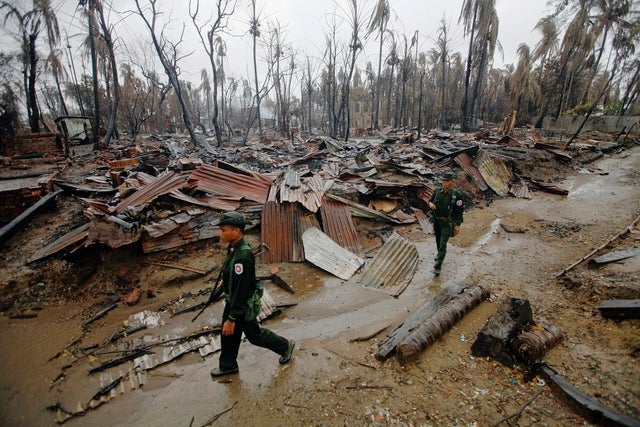
Human Rights Watch documented the destruction of Buddhist temples, mosques, and thousands of Arakan and Rohingya houses that were burned to the ground during the sectarian violence, leaving an estimated 90,000 people displaced and taking segregated refuge in temporary camps and community sites. Hundreds of Rohingya fled across the nearby border to Bangladesh, where many were forced
back by Bangladeshi border guards.

“The violence in Arakan State has devastated both the Rohingya and Arakan communities, but government efforts to identify and arrest those responsible should not result in further abuses,” Pearson said. “The sectarian violence and state of emergency provides no excuse for the security forces to continue their past record of abuses and discrimination against the Rohingya community.”

The Burmese government restricts international access to northern Arakan State – an area comprising the predominantly Muslim townships of Maungdaw, Buthidaung, and Rathedaung – and severely curtails freedom of movement for Rohingya residents. The Nasaka’s
long history of arbitrary detentions, torture, and other ill-treatment of Rohingya detainees heightens concerns about the recent mass arrests, Human Rights Watch said.

The government has not allowed independent investigations in the affected areas since the violence began. On June 6, Thein Sein ordered a high-level government committee to investigate the causes of the violence, identify the perpetrators, and issue recommendations. The committee is scheduled to present its findings by August 30. However, there are concerns about the independence and objectivity of the investigation committee, given that it includes
local security forces and Arakan State officials, Human Rights Watch said.

The government should invite the UN special rapporteur on human rights in Burma, Tomas Quintana, to Arakan State to conduct an urgent visit to investigate the violence and conduct of the security forces, Human Rights Watch said. The authorities should immediately disclose the location of all detention centers, provide the names of all detainees, bring them promptly before a judge, and allow independent humanitarian agencies access to all facilities.

Human Rights Watch urged the United States, European Union, ASEAN, Australia, Japan, and other countries concerned about human rights in Burma to press the government to allow an independent and thorough investigation of the violence, and to ensure that the basic rights of those detained are respected. They should also call upon the Bangladesh authorities not to return or push back those fleeing violence and to provide them temporary protection.

“The Burmese government should demonstrate that the political changes taking place in the country extend to the ethnic areas, and that abuses by local authorities will not be tolerated,” Pearson said. “This means stopping the violations, holding abusive officials to account, and promptly permitting an independent investigation

Burma's Misled Righteous

Sectarian rioting in western Burma has pitted the majority Buddhist population against a small Muslim minority group. Dozens of people on both sides have been killed, and countless homes destroyed. Thousands of refugees have taken flight.
This ethnic conflict has also had other, less conspicuous effects. Most importantly, it has triggered a dramatic realignment of political allegiances in the country. In a spectacular volte-face, a number of prominent members of Burma's pro-democracy opposition have begun calling for collaboration between civilians and the military in a bid to drive out what they claim are illegal Muslim immigrants who threaten the delicate fabric of Burmese society.
This recasting of the armed forces as protectors of the nation amounts to something of a coup for the quasi-military government that came to power a little over a year ago. Numbers of parliamentarians and exiled activists consider the Rohingya, an 800,000-strong Muslim group of South Asian descent who inhabit a pocket of Arakan state, to be a greater threat to the overall health of the country than a reinvigorated military. Yet this is the very same military that has spent decades persecuting the political opposition, forcing tens of thousands into prison or exile. It also happens to be one of the few institutions in Burma not touched by the reform program, as demonstrated by the army's continuing war against some of the country's restive ethnic minorities.
The government will see the flood of nationalist sentiment as a gift. Indeed, there is good reason to believe that officials may have had a role in whipping it up, as they did prior to the anti-Chinese riots of 1967 and the bouts of communal unrest involving Rohingya in 1978 and 1992. According to a Human Rights Watch report, security forces are actively persecuting ethnic Rohingya during this most recent bout of violence. The current riots serve to distract from ongoing ethnic conflicts in the north, public anger at rising electricity prices, and industrial workers' strikes in Rangoon, all of which have threatened the government's standing in recent months. The conflict also puts Aung San Suu Kyi in an awkward position, forcing her to choose between the morally unassailable but politically unpalatable high ground (since defending the Rohingya likely entails losing a large number of votes), or a more populist stand that yields to widespread bigotry. In the event, she has chosen to split the difference, speaking vaguely of a need to reform Burma's citizenship law as a way of resolving the conflict.


Currently leading the anti-Rohingya charge is the Rakhine [Arakan] Nationalities Development Party, which came in second in the province in the last general election of November 2010. They released a statement last week warning that the population of the Rohingya -- whom they label "Bengali immigrants" -- has reached "very alarming" levels, and called for swift action to segregate them from Arakanese and eventually resettle them overseas. Party Head Dr. Aye Maung, who had welcomed Suu Kyi's win in parliamentary by-elections in April "as a great chance for all of us to change Burma to a democratic country," recently called for Burma "to be like Israel" -- apparently a reference to the oppressive controls placed on Palestinians to ‘protect' Israelis. He urged civilians to work with the government to craft a policy to "defend this region" against the Rohingya, who "will be repeatedly trespassing on our territory."
Aye Maung is not alone. Religious figures and veterans of the pro-democracy movement have played a firm hand in stirring tensions, using language reminiscent of that which accompanied the Nazi pogroms. Ko Ko Gyi, a dissident who spent years behind bars for his leading role in the 1988 student uprising against military rule, has referred to the Rohingya as terrorists, and asserted that they are not an ethnic Burmese group but rather "[infringe] on our sovereignty." Such comments provide succor to the likes of Htay Oo, the powerful agriculture minister and a leading political hardliner. He has mooted the re-launch of Operation Dragon King, which was deployed under the guise of an anti-mujahideen campaign in the late 1970s to round up, arrest, and torture thousands of Rohingya, eventually forcing more than 200,000 into Bangladesh.
Playing the "terrorism" card conveniently separates the Rohingya, whose armed struggle ended a decade ago, from the ethnic "freedom fighters" elsewhere in the country. Few have asked how this distinction was reached, although unsubstantiated claims that Rohingya had been recruited by Al Qaeda gathered steam in the wake of 9/11, helping to cast the group as a malevolent force without needing to showcase evidence.

About Me

My photo
Maung daw, Arakan state, Myanmar (Burma)
I am an independent man who voted to humanitarian aid.