Muslim women hold their children at their house in Sittwe, June 6, 2012.
The United States is working with the international community
to find a resolution to the troublesome Rohingya issue, including
possible citizenship for members of the Muslim minority group in Burma,
officials say.
But rights groups do not see significant moves
under way by the Burmese government to fully address the problem, even
in efforts to pave the way for the return home of thousands of Rohingyas
displaced by deadly violence in northwestern Rakhine state in June.
State
Department refugee expert Kelly Clements said that recent talks between
the U.S. and Burma have “explored how the international community can
assist the Burmese government in long-term recovery efforts” following
the violence, in which more than 80 died and 75,000 were displaced,
mostly Rohingyas.
Additionally, an end to the Rohingyas’
stateless status must be found for those members of the group who can
make valid claims to citizenship, Clements said on Tuesday at a forum
held by the Open Society Foundation in Washington.
“We explored
how the international community can assist the Burmese government in
long-term recovery efforts and the development of a path to citizenship
for those Rohingya with claims.”
“Peace is possible in Rakhine
State only through economic development, poverty alleviation and
ensuring basic rights for residents,” Clements said.

Stateless
The Rohingya are not recognized as an ethnic group in
Burma even though many members of the group have lived in the country
for decades. They have been classified by the U.N. as one of the world’s
most persecuted minorities.
Clements said citizenship is often
the gateway to a person’s ability to realize a range of human rights and
basic services, including freedom of movement, freedom from
discrimination and arbitrary arrest and detention, the right to vote,
access to education, and property ownership.
“Citizenship is a
core concept that defines the relationship between a state and an
individual—each has obligations to the other.”
The Rohingya, a
people whose ethnic identity and origin are highly disputed, were
rendered stateless in Burma by the passage of the 1982 Myanmar
Citizenship Law.
Clements said that some historical accounts
note that Rohingyas have been indigenous to Rakhine since the 9th
century.
Rakhine was at one time the kingdom of Arakan, which
also occupied southern parts of modern Bangladesh. Burma's 800,000
Rohingya speak a dialect similar to one spoken in Bangladesh, where some
300,000 Rohingya also live.
Other accounts claim that the
Rohingya migrated to the region during the British colonial period,
Clements said.
“This latter claim has consistently fueled
anti-Rohingya sentiment, leading to periodic tension and violence
against the Rohingya by the former military regime after Burma gained
independence.”
Clements said that peace in Rakhine state, where
more than 80 died in the June violence by official count, and where
about 75,000 from both the Rohingya and the Rakhine Buddhist communities
remain displaced, will be restored only through economic development,
poverty alleviation, and guarantees of basic rights for residents.
The
U.S., she said, is working closely with the international community and
countries affected by Rohingya displacement to reach a “comprehensive,
sustainable, and just solution to their plight.”
“Our commitment
to resolving this intractable problem is clear,” Clements said.
'Nothing
on track'
Despite talks between the United States and Burma,
though, rights groups do not expect any resolution to the issue soon.
While
discussions on bringing peace to Rakhine have taken place, “nothing
that needs to happen is on track to happen,” said Human Rights Watch
Asia advocacy director John Sifton, also speaking at the Open Society
Foundations.
“The current situation is intolerable,” Sifton said.
“Huge
amounts of political pressure need to be placed on the Burmese
government to make things happen, and that’s pressure that the United
States government and the EU [European Union] will have to bring to
bear.”
Following the June violence in Rakhine, Burma’s national
government seemed to have no plan to return people to their homes,
Sifton said.
“Unfortunately, [this] still seems to be the case.”
The
United States and other concerned countries should ask the U.N. High
Commissioner for Human Rights to set up an office in Burma to serve as a
“neutral arbiter of facts and recommendations,” Sifton said.
Though
Burma now receives regular visits from U.N. Special Rapporteur for
Human Rights Tomas Quintana, an established office could fully monitor
the post-violence situation in Rakhine, the release of Burmese political
prisoners, and cease-fires negotiated with Burma’s other ethnic groups,
Sifton said.
“So from the beginning, we’ve been raising this as a
thing that needs to be done and could have a huge impact for all of
Burma.”


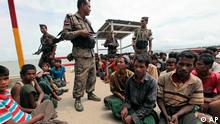 Bangladesh has started turning Rohingya away


