Monday, 18 June 2012

Rohingya refugees need access to healthcare: MSF

With unrest in Burma’s Rakhine State, many Muslims and Buddhist are now unable to receive adequate health care, says Médecins Sans Frontières, which has been forced to suspend its operations in the area.


When sectarian violence erupted on June 9, it put its local clinic staff in danger, MSF said in a statement on Monday.

“MSF is extremely worried that victims of the clashes are not receiving emergency care, and about the ongoing healthcare needs of our patients,” said Joe Belliveau, MSF operations manager. “Our immediate concerns are to provide emergency medical services, get food and supplies to people, and get our HIV patients their lifesaving treatment.”

In their effort to find a safe haven from the threat of continued violence, people are trying to flee to southern Bangladesh. MSF said it is concerned by reports that the Bangladesh government has denied access to people attempting to flee the violence and seek healthcare across the border. MSF also provides medical services in Bangladesh, and is ready to treat anyone in need of assistance, regardless of their origins, it said.

“People seeking refuge and in need of food, water and medical care should be allowed to cross the border,” said Belliveau. “In both Myanmar and Bangladesh, MSF is trying to reach those affected by the violence, but they should also be allowed to reach us.”

In Rakhine (Arakan) State, MSF has provided medical services for 20 years focusing on maternal health and infectious diseases such as malaria, diarrhea, HIV/AIDS and tuberculosis. In 2011, MSF conducted more than 487,000 consultations, and had over 600 patients on anti-retroviral treatment for HIV/AIDS. In addition to meeting immediate emergency needs, the return to a safe environment is needed to get MSF programmes back on track for longer-term health and well-being of people from all communities throughout the state, said the non-profit health service.

It said the MSF medical programme in Burma is one of its largest in the world. MSF is the country's main AIDS treatment provider and has been at the forefront of the fight against malaria.

More people became refugees last year than in any year since 2000, UN reports

OTTAWA - A new report by the United Nations refugee agency says more people became refugees last year than in any year since 2000.

The UN High Commissioner for Refugees' report says 4.3 million people were newly displaced in 2011, with 800,000 fleeing their countries and becoming refugees.
A Bangladeshi security officer gives water to Rohingya Muslims, fleeing from ethnic violence in Myanmar between Buddhists and minority Rohingya Muslims, on a boat jetty at Shahporir Dwip in Taknaf, Bangladesh, Monday, June 18, 2012. A border guard official says they have detained 128 Rohingya refugees seeking shelter from sectarian violence in western Myanmar. Bangladesh has refused to allow the refugees in despite call by the United Nations. (AP Photo/Saurabh Das)
In total, 42.5 million people ended 2011 as refugees, internally displaced or in the process of seeking asylum.

The UNHCR report attributes the high numbers last year to a string of humanitarian crises brought on by drought and conflict in the Middle East and Africa.

"2011 saw suffering on an epic scale. For so many lives to have been thrown into turmoil over so short a space of time means enormous personal cost for all who were affected,” said Antonio Guterres, the UN’s High Commissioner for Refugees, in a statement.

“We can be grateful only that the international system for protecting such people held firm for the most part and that borders stayed open. These are testing times.”

Canada ranked ninth on a list of main destination countries for new asylum seekers, and together with the United States, admitted four-fifths of all the refugees resettled by the UN in 2011.

The UNHCR representative in Canada says the country is highly regarded for its work on helping people displaced around the world find a new home.

"Canada is a country that is very important to us with respect to the solutions of refugee problems," said Furio De Angelis.

But De Angelis says there are concerns about the Conservative government's recent changes to refugee laws.

Among other things, the UNHCR had originally sounded the alarm over provisions in Bill 31, also known as the Protecting Canada's Immigration System Act, which would have allowed for the detention, without review for one year, of people designated as being part of "mass arrivals" in Canada.

That provision was later amended by the government to require detention review at the 14-day mark and then again six months later.

But De Angelis said those and other changes made to the proposed law haven't alleviated all of the UNHCR's concerns.

He is expected to testify before a Senate committee Monday to address them.

Also, at the end of this month, most refugees will be losing access to extended health care benefits.

Currently, the federal government provides basic health care, dental and vision care and medication to all refugee claimants until they become eligible for provincial coverage.

The changes to the interim health care program sharply curtail the benefits, a move the government says will save more than $100 million over the next five years and ensure refugee claimants don't get better access to health care than Canadians.

Canadian doctors and other health care providers say the cuts are unjust and are planning a protest on Monday.

De Angelis said the UNHCR is concerned about the way the shaky global economy is affecting refugee protection.

"We know that there will be a challenge in resources with respect to meeting humanitarian needs and we have indications from donor countries that that will be the case for obviously reason, given the financial and economic downturn in so many traditional donor countries," he said.

The other concern facing the UNHCR is the fact there is no end in sight to the conflicts plaguing the top refugee producing countries, like Afghanistan, Somalia and Sudan.

"We really don't see the seeds of a durable political solution to such old conflicts," De Angelis said.

On average last year, one out of four refugees in the world were from Afghanistan, with the majority settling in Pakistan and Iran, the report said.

According to figures provided by Citizenship and Immigration, only 419 refugee claims from citizens of Afghanistan were received in Canada last year.

Rohingyas coming in again

BGB men offer lunch, dry food, water before sending them back
Rohingyas eat ravenously under the watchful eyes of BGB members at Shah Porir Dweep jetty of Teknaf yesterday. Though they are not welcome in Bangladesh, border guards offer them a meal before sending them back. Photo: Anurup Kanti DasJulfikar Ali Manik and Dwaipayan Barua, from Teknaf

After three days of almost no intrusion attempts by Rohingyas, around 148 boat people from Myanmar tried to enter Bangladesh from Sunday night till yesterday afternoon.

A small group of seven attempted to flee into Teknaf from June 14 to early Sunday, while yesterday alone eight fishing boats full of 140 headed for Teknaf shores.

All the 140, except for a minor girl who claimed to be Bangladeshi, were male Rohingyas and they left their villages fearing “arrest by Myanmar army”.

Locals and officials, who breathed a sigh of relief thinking that Rohingyas had stopped escaping the neighbouring Myanmarese state of Rakhine to Bangladesh, became worried at this fresh influx bid.

The Rohingyas were sent back to Myanmar by boats with dry food and water. The girl was kept in BGB custody for identity verification.

The intruders came from the villages of Maungdaw, a town of the Western Rakhine state, bordering Teknaf upazila of southern Cox's Bazar district.

It was around 11:00am yesterday when the BGB and coast guard saw from the Shah Porir Dweep coast some five Rohingya boats bobbing in the river.

After the Rohingyas had ignored directives to go back, the forces brought them to the Shah Porir Dweep jetty. Another two groups of boat people, caught by the forces a few hours earlier, were also kept there.

Around 3:00pm, a small boat of seven Rohingyas trying to make an entry through the river was stopped by a coast guard team. This group, too, was taken to the jetty.

The BGB provided meal for all the intruders.

Some locals of Shah Porir Dweep also bought from a local store some dry food and bottles of mineral water for the Rohingyas.

The store owner, Nurul Absar, who also donated some dry food, told The Daily Star that the locals were helping the Rohingyas on humanitarian and religious grounds.

Absar, however, said providing shelter to Rohingyas in Bangladesh was not a good idea. “Myanmar is their [Rohingyas'] country; their government has to solve their problem.”

He said the countries that were concerned about Rohingyas should put pressure on Myanmar to resolve the crisis.

Also, two boats carrying eight Rohingyas were intercepted by guards in Sabrang and Naitong areas in the morning and all of them were pushed in the course of the day.

Local officials who keep themselves updated about the developments in the neighbouring country said there was a “cordon and search operation” at Maungdaw on Saturday and Sunday nights.

The Myanmar army arrested many male villagers from the town and those who were picked up were still traceless.

Lt Col Zahid Hassan, commanding officer of BGB 42 Battalion at Teknaf, told The Daily Star, “As they [Rohingyas] are aware of the hospitality of Bangladeshis, they prefer to come here instead of looking for safe places within Myanmar.”

Zahid said the BGB had fed the intruders on humanitarian grounds.

But some other officials in the force and local administration say if the other Rohingyas came to know about this hospitality they would prefer to come to Bangladesh.

About yesterday's intrusion attempts, Zahid talked to Myanmar border force Nasaka. “Nasaka claimed they didn't send the Rohingyas to Bangladesh forcefully.”

Things were different in 1991, during the second influx of Rohingyas as refugees, when the Myanmar government itself sent them forcefully.

Yesterday, one of the Rohingyas, identifying himself as Mir Ahmad, 25, claimed that on Sunday he along with his younger brother and two nephews fled his village at Bakghona of Maungdaw after Maghrib prayers fearing possible arrest.

They started on a boat with 15 others aboard from a nearby coast in the dark and escaped Nasaka vigilance, but were intercepted by the BGB.

He said Rohingya males of the village were being taken by some unknown people to unknown places in the last few days and none of them had returned home. Asked, Ahmad could not give any details.

Ahmad Shah, another intruder, said he had fled his village at Padongcha two days back and remained in hiding in a forest.

He got on a boat yesterday morning and tried to enter Teknaf but failed.

When the Rohingyas tried to come to Bangladesh yesterday morning, there were more then a hundred Bangladeshi boats in the Naf River near Shah Pori Dweep for fishing.

They rowed across as if theirs were fishing boats like any other.

Refugees Flee Violence in Rakhine

 Rakhine refugees live in camps and are afraid to return home while Rohingya fleeing by boat are turned back by Bangladesh.
Tensions appear to have cooled in western Burma’s Rakhine state following clashes between ethnic Rakhine Buddhists and Rohingya Muslims but tens of thousands displaced by the violence face aid shortages and remain afraid to return home.
Troops patrolled the streets of the state capital Sittwe Friday, where weekly Muslim prayers were cancelled and a dawn-to-dusk curfew remains in place as the sectarian strife left at least 29 people dead since June 8.
Nearly 32,000 people have been displaced and are living in 37 camps that have been set up for both Rakhine and Rohingya across the state, officials said.
North of the capital, people fleeing the fighting are straining resources in Yathetaung township, where 12,000 people, mostly Rakhine Buddhists, are living, a local official said.
Hla Myint, township chairman of the Rakhine Nationalities Development Party (RNDP), told RFA Friday that aid is being sent to neighboring Buthitaung and Maungdaw townships, but not to the 14 camps in Yathetaung.
"The help hasn't arrived in Yathetaung yet,” adding that there had only been enough aid and supplies for the first 5,000 of the displaced.
"We were able to help them at the beginning, but not anymore. We need things like sheets, bedding, and other items.”
“There is no camp opened by authorities. All refugee camps are opened and run by local people and groups.
We use schools and Buddhist temples for camps, and have sent some 3,000 refugees to private homes. Some refugees are in the villages,” he said.
According to official estimates Thursday, nearly 2,600 homes, some 1,200 of them ethnic Rakhine and some 1,300 Rohingya, had been destroyed in the violence.
The UN refugee agency, which sent monitors to the region this week, said the need for food, shelter, and medical attention for the displaced could be “considerable.”
rakhine-map-sittwe-400
Rohingya
Some Rohingya fleeing the violence by boat to neighboring Bangladesh, already burdened with about 300,000 Rohingya living in its poor southeast, have been turned back, the agency said.
Urging Bangladesh not to block the boats, the office of the United Nations High Commissioner for Refugees said in a statement Friday it was “deeply concerned” about “dramatic scenes” of boatloads of refugees.
"The UN refugee agency has first-hand, credible accounts of boats from Myanmar not being enabled to access Bangladeshi territory. These reports indicate women, children and some wounded are on board,” the statement said.
“There are now a number of boats drifting in the mouth of the Naf River with desperate people onboard in need of water, food and medical care.”
Decades of discrimination in Burma and elsewhere have left the Rohingya, of which some 800,000 live in Rakhine, stateless and viewed by the United Nations as among the most persecuted minorities in the world.
Aside from Bangladesh, an estimated 30,000 Rohingya live in Malaysia, where several thousand turned out for a protest near the Burmese embassy in the capital Kuala Lumpur Friday, demanding an immediate end to the violence in Rakhine.
Foreign assistance
The Burmese government regards the Rohingya as illegal immigrants from Bangladesh even though many of them have lived in the country for generations.
U.S. and other Western nations were monitoring how the Burmese government was handling assistance to victims in the aftermath of the Rakhine violence, which has drawn worldwide attention to the Rohingya.
Following a meeting with U.S. officials on aid for Rakhine state, RNDP Chairman Aye Maung told RFA that his party thought development assistance from the UN in the state had been unevenly biased towards Muslims and had left out Rakhine people.
“All the money they spent went to only one religious group [Muslims], and Buddhist Rakhine got four to five percent at most of all humanitarian assistance there,” he said, after discussing future plans for assistance with U.S. Embassy’s Charge D’Affaires Michael Thurston Thursday.
“If this kind of differentiation based on race and religion continues as it was in the past, we will lead the protest against the UN program when UN offices open in Rakhine. We also discussed citizenship law and immigration law with him."
“We need to look into [the ethnic strife] deeply and deal with it skillfully,” he said. “We cannot say the problem will be solved merely by shaking hands.”
Thurston also met with leaders of five Muslim groups in Rangoon to discuss the unrest in Rakhine.
“He asked what kind of humanitarian assistance we need and how he can help. We talked about the food needed there. He said he would inform Washington and get the help as soon as possible,” Burma Muslim League secretary Kyaw Khin told RFA.
Aung San Suu Kyi
Meanwhile, Burmese opposition leader Aung San Suu Kyi arrived Friday in Oslo, where she will pick up her 1991 Nobel Peace Prize, following an address to Swiss parliament.
The 66-year-old democracy campaigner is on a tour of Europe, her second trip abroad after having spent most of the past two decades under house arrest.
At a press conference on the first stop of her trip in Geneva, she said that "the most important lesson" from the Rakhine conflict was "the need for rule of law," which she added was also key to resolving the numerous armed ethnic conflicts in the country emerging from decades of harsh military rule.

Violence Throws Spotlight on Rohingya by RFA

As violence rages in Rakhine state, will the Burmese government confront head-on the long-running issue of a stateless Muslim group?

AFP

A Rohingya Muslim family seen in the Burmese-Bangladesh border after fleeing violence in Burma's Rakhine state, June 12, 2012.

The week-long sectarian violence between Buddhists and Muslims in Burma's western Rakhine state has thrown the spotlight on the Rohingya, one of the most oppressed groups in the country, and compels the government to address a burning issue that has been swept under the carpet for decades.

Most of the estimated 800,000-strong Rohingya Muslim minority in Burma live in Rakhine, a predominantly Buddhist state bordering Bangladesh where dozens of people have been killed in clashes triggered by the rape and murder last month of a Buddhist girl, allegedly by three Muslims, and the June 3 lynching of 10 Muslims in apparent retaliation.

In revenge attacks, Rohingya mobs in the state's capital Sittwe burned the homes and businesses of ethnic Rakhine Buddhists, and the army opened fire and allegedly killed Rohingyas, according to Human Rights Watch. Mobs of Rohingyas and Buddhists armed with sticks and swords have also gone on a rampage, burning hundreds of homes and resulting in numerous deaths.

Experts say Rakhine has always been a tinderbox of hatred between the two communities with the potential to explode, laying the blame largely on the Buddhist-majority government for regarding the Rohingya as illegal immigrants from Bangladesh and rendering them stateless even though many of them have lived in the country for generations.

"What has happened recently is just more of a symptom of a long history of really horrible discriminatory treatment of the Rohingya," Kelley Currie, a former Asia policy adviser in the U.S. State Department, told RFA.

Burmese authorities, particularly the military junta which ruled the country repressively for half a century until it was replaced by a nominally civilian government in March last year, "have handled this situation badly for decades, have encouraged this mentality among the people that these individuals are stateless, and made little efforts to integrate them or resolve this problem in a sustainable way," she said.

The religious dimension of the Rohingya problem is particularly troubling and one which people seldom talk about, said Currie, now an expert at the Washington-based Project 2049 Institute.

"The military junta over the past 20 years has really emphasized Buddhism as the religion of the 'true' Burmese people, and they have been cited repeatedly for religious persecution by the United States," she said.

Blacklisted

The government's refusal to recognize that the Rohingya are Burmese citizens is among reasons why Burma has been blacklisted by the U.S. State Department as a "country of particular concern" in its annual surveys on international religious freedom.

Aside from being stateless, the Rohingya are subject to a rule, embedded in marriage licenses, that they are only permitted to have two children, rights groups say. They lack access to health care, food, and education and are subject to forced labor and travel restrictions.

They are widely regarded within Burma as “Bengalis”—a term for people of Bangladeshi nationality.

The current government of President Thein Sein, which has been lauded for implementing political and economic reforms over the last year, has come under criticism for continuing the junta's discriminatory policies towards the Rohingya.

“There is no change of attitude of the new civilian government of U [honorific] Thein Sein towards Rohingya people; there is no sign of change in the human rights situation of Rohingya people. Persecution against them is actually greater than before,” said Nurul Islam, president of the London-based Arakan Rohingya National Organization, according to the IRIN humanitarian news agency in a March dispatch.

The Rohingya were given voting rights in Burma's landmark 2010 elections and, according to the report, were promised citizenship if they voted for the military regime’s representatives.

“Citizenship is still not restored,” said Islam. “Killing, rape, harassment, torture, and atrocious crimes by border security forces and armed forces have increased. The humiliating restrictions on their freedom of movement, education, marriage, trade, and business still remain imposed.”

Thein Sein has said that the violence in Rakhine, known as Arakan State in British colonial times, was fueled by dissatisfaction harbored by different religious and ethnic groups and the desire for vengeance, warning that it could scuttle his reform agenda which is key to lifting of international sanctions.

"Damage .. .could be done to the peace, stability, democratic process, and development of our country during its period of transformation, if the unrest spreads," he said.

Negotiations

Thein Sein's reform plans include negotiations with armed ethnic groups fighting for autonomy. Rohingya activists demand recognition as a Burmese ethnic group, claiming a centuries-old link to Rakhine state.

"The plight of Rohingyas should be an integral part of any reconciliation program involving ethnic groups," said T. Kumar, international advocacy director at Amnesty International.

"Ethnic minorities in general and Rohingyas in particular have been shortchanged," he said.

But even some pro-democracy dissidents from Burma's ethnic Burman majority, which makes up nearly 70 percent of the country's population, refuse to acknowledge the Rohingyas as compatriots.

“We have not said anything about this for a long time, but now we have to express our views on the Rohingya,” said Ko Ko Gyi, a prominent leader of the 88 Generation Students, a pro-democracy organization founded by leaders of 1988 anti-government street protests.

“The Rohingya are not a Burmese ethnic group. The root cause of the violence ... comes from across the border and foreign countries,” he said, adding that countries that criticize Burma for its refusal to recognize the Rohingya should respect its sovereignty.

Against the backdrop of the current Rohingya crisis, confronting the ethnic problem will be the "most difficult challenge" for Thein Sein's government, said Suzanne DiMaggio, the vice-president of New York-based Asia Society's Global Policy Programs.

"Unless and until the ethnic problems are resolved, all of the progress made in the reform area could be wiped away," she said. "Ultimately, if the country wants to have a cohesive population, the ethnic issues have to be looked at in a comprehensive way. That is very difficult to do."

Will the violence then force Thein Sein's government to confront the Rohingya issue head on?

"The fact that it has gotten a very strong international reaction, including a strong statement from the United States, I think has pushed this issue up their priority list and they will have to address it; they will have to do something about it," Currie of Project 2049 Institute said.

"But I wouldn't expect them to do anything to resolve this issue in a very sustainable way. I expect them to do whatever they need to do to get this off the front pages and get it out of people's attention and tamp it down for the time being so that people aren't bothering them about it."

Rohingya Muslims Persecuted In Myanmar And Bangladesh


BANGKOK — They have been called ogres and animals, terrorists and much worse – when their existence is even acknowledged.

Asia's more than 1 million ethnic Rohingya Muslims are considered by rights groups to be among the most persecuted people on Earth. Most live in an anachronistic purgatory without passports, unable to travel freely or call any place home.

In Myanmar, shaken this week by a bloody spasm of violence involving Rohingyas in which dozens of civilians died, they are almost universally despised. The military junta whose half-century of rule ended only last year treated them as foreigners – fueling a profound resentment now reflected in waves of vitriol being posted online.

"People feel it very acceptable to say that 'We will work on wiping out all the Rohingyas,'" said Debbie Stothard, an activist with the Alternative ASEAN Network on Burma, referring to hyperbolic Internet comments she called "disturbing."

The Myanmar government regards Rohingyas mostly as illegal migrants from Bangladesh, even though many of their families have lived in Myanmar for generations. Bangladesh rejects them just as stridently.

"This is the tragedy of being stateless," said Chris Lewa, who runs a non-governmental organization called the Arakan Project that advocates for the Rohingya cause worldwide.

"In Burma they're told they're illegals who should go back to Bangladesh. In Bangladesh, they're told they're Burmese who should go back home," Lewa said. "Unfortunately, they're just caught in the middle. They have been persecuted for decades, and it's only getting worse."


That was made painfully clear this week as Bangladeshi coast guard units turned back boatload after boatload of terrified Rohingya refugees trying to escape the violence in Myanmar's Rakhine state. The clashes between Rohingyas and ethnic Rakhine Buddhists have taken a roughly equal toll on both communities, though each blames the other for the violence.

The boats were filled with women and children, and Bangladesh defied international calls to accept them, saying the impoverished country's resources are already too strained.

A few have slipped through, including a month-old baby abandoned Wednesday in a boat after its occupants fled border guards. Three other Rohingyas have been treated for gunshot wounds at a hospital in the Bangladeshi town of Chittagong, including one who died.

The unrest, which has seen more than 2,500 homes charred and 30,000 people displaced internally, erupted after a mob lynched 10 Muslims in apparent retaliation for the rape and murder last month of a 27-year-old Buddhist woman, allegedly by Muslims.

On Thursday, Rakhine state was reportedly calm. But Rohingyas living there "very much feel like they're trapped in a box," said Phil Robertson of Human Rights Watch. "They're surrounded by enemies, and there is an extremely high level of frustration."

The grudges go back far. Bitterness against the Rohingya in Myanmar has roots in a complex web of issues: the fear that Muslims are encroaching illegally on scarce land in a predominantly Buddhist country; the fact that the Rohingya look different than other Burmese; an effort by the former junta to portray them as foreigners.

Across the border in Bangladesh, civilians – not the government – are more tolerant. But even there, Rohingyas are largely unwanted because their presence in the overpopulated country only adds to competition for scarce resources and jobs.

Myanmar's government has the largest Rohingya population in the world: 800,000, according to the United Nations. Another 250,000 are in Bangladesh, and hundreds of thousands more are scattered around the world, primarily the Middle East.

Human Rights Watch and other independent advocacy groups say Rohingyas face discrimination routinely. In Myanmar, they are subjected to forced labor by the army, a humiliation not usually applied to ethnic Rakhine in the same area, Lewa said.

Rohingyas must get government permission to travel outside their own villages and to marry. Apparently concerned about population growth, authorities have barred Rohingyas from having more than two children.

In 1978, Myanmar's army drove more than 200,000 Rohingyas into Bangladesh, according to rights groups and the U.S. Campaign for Burma. Some 10,000 died in squalid conditions, and the rest returned to Myanmar. The campaign was repeated in 1991-1992, and again a majority returned.

In 2009, five boatloads of haggard Rohingya migrants fleeing Myanmar were intercepted by Thai authorities. Rights groups allege they were detained and beaten, then forced back to sea, emaciated and bloodied, in vessels with no engines and little food or water. Hundreds are believed to have drowned.

The same year, Myanmar's consul general in Hong Kong – now a U.N. ambassador – described the Rohingya as "ugly as ogres" in an open letter to diplomats in which he compared their "dark brown" skin to that of the "fair and soft" ethnic Burmese majority.

The latest unrest has focused fresh attention on the Rohingyas' plight, but it has also galvanized a virulent new strain of resentment. Many Burmese have taken to the Internet to denounce the Rohingya as foreign invaders, with some comparing them to al-Qaida and the Taliban.

While vitriol has come from both sides, what makes the latest unrest unique is that virtually "the entire population is openly and completely against" them, said Sai Latt, a writer and Myanmar analyst studying at Canada's Simon Fraser University.

"We have heard of scholars, journalists, writers, celebrities, even the so-called democracy fighters openly making comments against Rohingyas," Sai Latt said.

One Burmese actress posted "I hate them 100%" on her Facebook wall on Monday as the fires burned. By Thursday, her comment had nearly 250 "likes."

Prominent Burmese language journals have reported "only the Rakhine side," Sai Latt said. And many people have lashed out at foreign media, accusing them of getting the story wrong.

Ko Ko Gyi, a prominent former political prisoner released in January, has said Rohingyas should not be mistreated but added they "are not an ethnic group in Myanmar at all." He blamed the recent violence on illegal migrants from Bangladesh.

The longtime leader of Myanmar's democracy movement, Aung San Suu Kyi, has shied away from the blame game, saying the problem should be tackled by fair application of the law.

Speaking in Geneva on a five-nation European tour, she said that "without rule of law, such communal strife will only continue.

"The present situation will need to be handled with delicacy and sensitivity," she told reporters.

The tide of nationalistic sentiment against the Rohingya puts Suu Kyi in a difficult position. Her conciliatory message risks alienating large blocs of supporters at a time when she and her National League for Democracy are trying to consolidate political gains attained after they entered Parliament for the first time in April.

The Rohingya speak a Bengali dialect similar to one spoken by residents of southern Bangladesh. And physically, they are almost indistinguishable from their Bangladeshi counterparts, said Lewa, of the Arakan Project.

But their history – specifically the amount of time they've lived in Myanmar, and who among them qualifies as a legitimate resident – is bitterly disputed.

Some say the Rohingya are descended from Arab settlers in the 7th century, and that their state was conquered by the Burmese in 1784. Later waves arrived from British-run colonial India in the 1800s, but like the colonists themselves, they were regarded as foreigners.

That view persisted through half a century of military rule. Myanmar's post-junta government does not recognize them as one of the country's 135 indigenous ethnic groups. And many people stridently believe they are not even a real ethnic group – rather, they are only illegal migrants from Bangladesh.

President Thein Sein has warned that any escalation could jeopardize the nation's fragile democratic reforms.

The International Crisis Group said that ironically, the nation's newfound freedoms may have helped contribute to the unrest.

"The loosening of authoritarian constraints may well have enabled this current crisis to take on a virulent intensity," the group said. "It is not uncommon that when an authoritarian state loosens its grip, old angers flare up and spread fast."

___

Associated Press writers Xinyan Yu, Jocelyn Gecker and Grant Peck in Bangkok and Frank Jordans in Geneva contributed to this report.

A litmus test for the new Burma by Zarganar


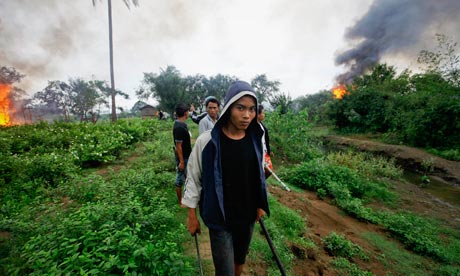
Men carry homemade weapons during the sectarian violence that has recently erupted in Burma's Rakhine state. Photograph: Reuters


Sunday 17 June 2012
As Aung San Suu Kyi is allowed to go to the UK ethnic violence threatens to undermine my country's transition to democracy


As a comedian, poet, film-maker and loudmouth, I often fell foul of the censors in Burma, where I was a political prisoner four times. Sometimes it was through deliberate provocation, such as my insistence on trying to include kidnap scenes in all of my films, where at some point the good guys would exclaim "we must free that lady!", a thinly veiled act of resistance which caught on in the industry and became obligatory for many film-makers during Aung San Suu Kyi's imprisonment.

My most recent sentence was for 35 years, imposed for criticism of the Burmese government's woeful response to Cyclone Nargis in 2008, and from which I was released last autumn as part of a mass amnesty. Yet I have also been imprisoned simply for using the internet. It might be interesting to learn that communications were policed by people who understood little about the technology they were patrolling. I don't think it takes a comedian to see the funny side of police confiscating my computer screen, but leaving the hard drive. Freedom of expression has been rigorously denied for a long time, but Burma is very definitely changing and, in this new world, new challenges are presenting themselves.

This week, Aung San Suu Kyi will visit Britain for the first time in 24 years. That she is now free to travel (as am I) is a hugely positive development. It reflects the changes taking place in Burma and there is much to be welcomed. Yet she and I are aware of an unwatched pot that is threatening to boil over at home – and may yet undermine the transition to democracy.

Last month sectarian violence erupted in Burma's Rakhine state on the Bangladesh border, where both Buddhist Rakhine (or Arakanese) and Muslim Rohingya minorities live. There is a history of inter-ethnic tension and violence dating back decades. The latest episode took place shortly after my arrival in London. I was sickened to read about the mob killing of 10 Rohingya men in retaliation for the alleged gang rape of a Rakhine teenage girl.

Now we are seeing a cycle of violence and reprisals, with homes and businesses burned to the ground and hundreds taking refuge in public buildings. A state of emergency has been declared in Rakhine state. There are reports of live ammunition being used to disperse crowds and curfews have been imposed.

The situation in the area is complex and dates back at least to our colonial history. There has been institutionalised discrimination against the Rohingya for decades. This is exacerbated by corruption among border enforcement officials, which has allowed illegal immigration and added to sectarian tensions.

The entire situation is a litmus test for reform in our country, including for improvements in freedom of expression. When I read some of the language being used on social media, both inside and outside the country, I am concerned that the Burmese people are using their new freedom to express views which incite racial hatred.

Distributing the Universal Declaration of Human Rights used to get you a jail sentence. Fortunately that is no longer the case. The declaration says all human beings are born free and equal in dignity and rights. So the Burmese government needs to exercise its responsibility to protect the rights of all those in Burma, whatever their religion or ethnicity. We need legal action to be taken against those who have committed murder and violence and damaged property. The government must restore the rule of law and end corruption and immigration abuse, but not while trampling on human rights like before. And we Burmese must use freedom of expression to promote peace, not conflict.

About Me

My photo
Maung daw, Arakan state, Myanmar (Burma)
I am an independent man who voted to humanitarian aid.